
RSRP Full Form In Telecom: Meaning, Values, Uses & Signal Quality
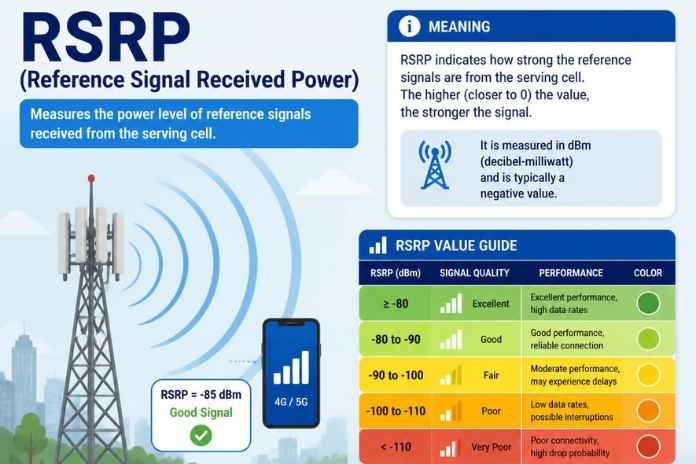
The full form of RSRP in telecom is Reference Signal Received Power. It is an important measurement for assessing the strength of LTE and other cellular networks, helping to determine how strong the reference signal is on the phone. In simple terms, RSRP helps explain how strong your mobile signal could be for data transmission, calls and stability in the network.
Have you ever wondered why your mobile shows full internet connectivity bars, yet the internet speed is still pretty slow? RSRP might be one of the answers to fix this problem. Let’s take a closer look at RSRP and compare it with equivalent telecom terms like RSSI and RSRQ.
What Does RSRP Mean in Telecom?
RSRP stands for Reference Signal Received Power. It indicates the power level of the reference signal coming from a cellular base station. Cell phones in LTE can estimate the signal quality on the reference signal and use it for cell selection, handover, and other measurement purposes.
Compared to the overall measurement of signal strength, RSRP measures the signal that the network is actually using for communication and measurements. This makes it much more beneficial than the older and more broad signals in numerous instances.
Why Is RSRP important?
RSRP is important because it helps show:
- How well can your phone “hear” the cell tower?
- Whether the connection is likely to be stable.
- How strong the LTE signal really is.
- Whether a device may need to switch to a better tower.
A strong RSRP usually means better LTE coverage. A weak RSRP can mean dropped calls, slower data, or trouble staying connected.
How RSRP Is Used In Mobile Networks?
Telecom networks use RSRP to measure and optimise the signal strength. Devices measure RSRP so the network can make decisions such as:
- Which cell the phone should connect to
- When to hand over a call or data session to another tower
- Whether coverage is good enough in a certain area
- How to tune antenna placement and network planning
For users, this means RSRP is one of the hidden numbers behind everyday mobile performance.
What RSRP Value Range Is Considered Good Or Bad?
RSRP is usually shown in dBm, which is a unit used to measure power levels.
Here is a simple general guide:
| RSRP value (dBm) | Signal Quality |
| Better than -80 dBm | Excellent |
| -80 to -90 dBm | Good |
| -90 to -100 dBm | Fair |
| Worse than -100 dBm | Weak |
| Worse than -110 dBm | Very weak |
These ranges can vary a little by device, network, and environment, but the general idea is the same: the closer RSRP is to zero, the stronger the received reference signal.
Example
- -75 dBm: Very strong signal
- -95 dBm: Usable, but not ideal
- -108 dBm: Weak signal, likely worse performance
What’s the Difference Between RSRP, RSSI, and RSRQ?
Many people confuse these terms. They are related, but they do not mean the same thing.
| Term | Full form | What it measures |
| RSRP | Reference Signal Received Power | Power of the LTE reference signal |
| RSSI | Received Signal Strength Indicator | Total received power, including noise and interference |
| RSRQ | Reference Signal Received Quality | Signal quality based on RSRP and RSSI |
Simple difference
- RSRP tells you how strong the useful LTE reference signal is.
- RSSI tells you the total signal power, including unwanted parts.
- RSRQ tells you how clean or efficient the signal is.
A phone may have a decent RSRP but poor RSRQ if there is too much interference or congestion.
Why Does RSRP Give a Better Picture of Signal Strength?
Signal bars are only a rough visual estimate. They can hide important differences in coverage and quality.
For example:
- Two phones may both show 3 bars
- One may have strong RSRP and good RSRQ
- The other may have acceptable RSRP but heavy interference
- The second phone may feel much slower even though the bars look similar
That is why telecom engineers and advanced users often rely on RSRP and related metrics instead of just bars.
What Affects RSRP?
Various factors can impact the RSRP and cause your mobile’s signal to be weaker or stronger. They include:
- The distance from the tower of your cell phone: The farther you are from the tower, the weaker the signal may be.
- Buildings and walls: Thick walls, concrete, and other obstructions could block or reduce the signal.
- Outdoor or indoor location: Signals are usually stronger outside than in a building.
- Terrain: Valleys, hills, as well as other obstacles could impact the way that signals can reach your device.
- Network load and interference The use of a network that is heavy as well as interference by other signal sources may impact the connectivity.
- Antenna and device location: Where your phone or antenna is situated could affect reception of signals.
- Weather and surrounding conditions: In some situations, the weather and environmental conditions can impact the quality of the signal.
Is RSRP Only Used In LTE Networks?
RSRP is most commonly associated with LTE. It is a major LTE radio measurement used for coverage and mobility decisions.
In newer networks, similar measurements exist for 5G and other technologies, but the exact terms and methods may differ. If your source material or audience specifically focuses on LTE, it is best to keep the explanation centred there.
Common Mistakes People Make When Reading RSRP
1. Thinking signal bars tell the whole story
Bars are only a rough visual guide. They do not show interference, congestion, or quality.
2. Confusing RSRP with speed
RSRP affects connection quality, but speed also depends on:
- Network load
- Spectrum availability
- Signal quality
- Carrier configuration
3. Ignoring RSRQ
A strong RSRP does not always mean good performance. RSRQ matters too.
4. Comparing readings without context
An RSRP value can appear different based on the following factors:
- Device model
- Measurement method
- Indoor or outdoor location
- Network band
When Should You Care About RSRP?
RSRP is useful when you are:
- Troubleshooting weak mobile data.
- Checking indoor coverage.
- Comparing network performance across locations.
- Planning a cellular site or antenna setup.
- Diagnosing handover or connectivity issues.
If you are just making normal phone calls and browsing casually, you may never need to look at it. But it becomes useful when signal problems appear.
FAQs – Frequently Asked Questions
1. Is RSRP the same as signal strength?
Not exactly. It is a more specific measurement of the LTE reference signal, while “signal strength” is often used loosely.
2. What is a good RSRP value?
A value around -80 dBm or better is usually considered acceptable, while values below -100 dBm are often weak.
3. Why does my phone show full bars but poor internet?
Because signal bars do not show everything. Interference, congestion, and poor RSRQ can still reduce performance.
4. Does RSRP affect call quality?
Yes, weak RSRP can contribute to unstable connections, which may affect call quality and data reliability.
Also Read: The Internet of Things (IoT): Definition, Development And Application